What a Buteo - a 2022 highlight
- Wild About Raptors - Emma
- Jan 1, 2023
- 4 min read
Updated: Mar 11, 2023
It was a sunny, breezy evening when I checked on the common buzzard (Buteo buteo) nest. Peering down the scope, appearing just over the lip of the nest, the brown plumage of the juvenile buzzard was barely visible, peacefully rising and falling with her steady breathing. I had been monitoring this nest for two months and I knew the chick would now be in the window when she would be the right size to be ringed. We ring as many birds as we can, under licence, to learn as much as possible about the lives of birds on our site. My interest specifically lies in fitting these lightweight and uniquely-numbered rings, or bands, to the legs of pulli birds – that is, very young birds that haven’t yet fledged the nest. The chick sleepily stretched out one wing, giving me a glimpse of her primary feather growth. It was enough to confirm my estimate of her age. As I took one more look through the scope before packing up to leave, the buzzard chick stood up and made eye contact with me down the scope. I snapped a photo before leaving, knowing it was time to get organised – the following day would be the day to ring our baby buzzard.
I went home and put together all my ringing gear and I looked over my books again. I went to sleep that night feeling confident and excited. But throughout the night, I was to be awoken by nightmares of chicks jumping, fledging too early – a process known as nest explosion. I woke up at 4am feeling sick with nerves. I knew I had expert guidance from the people around me but if anything – anything at all – went wrong, it would be my fault. Because it was me who asked to learn to ring raptors – I was learning, and the buzzard was being learned on. A team of people were coming together to make this happen – because I asked them to. The pressure I felt that morning was immense. This would be the first time I would see a raptor chick being extracted from an open nest and although I understood the process, I struggled to visualise our success.

The time had arrived, and joining Stuart and I was our trainer Colin, along with our two foresters Martin and Murray. Like the sunny evening before, the chick was lying down again. We grabbed all our ringing and climbing gear, left the vehicles on the dirt track, and approached the nest tree. The tree loomed high above us and we could see the bottom of the nest. I had never seen it from this angle, and it suddenly seemed impossibly high. Martin, our climber, harnessed up and made the ascent up the tree – it was too high to get to using ladders alone. With decades of climbing experience under his belt, Martin reached the nest quickly. He secured himself in position, eye level with the nest. It was a hot and humid morning and we had horseflies chewing at us whilst we waited for Martin to place the buzzard in a soft, white cotton bag to be lowered to us on the ground. Time stood still, and in my mind lingered those nightmarish images from the previous night. I literally held my breath as Martin reached into the nest. Martin shouted to us to let us know the buzzard was secure in the bag. I could breathe again – our baby buzzard was safe. I could hear the parent birds nearby, calling their raspy ‘pews’. They may have kept their distance from us, but they still let us know they were watching.

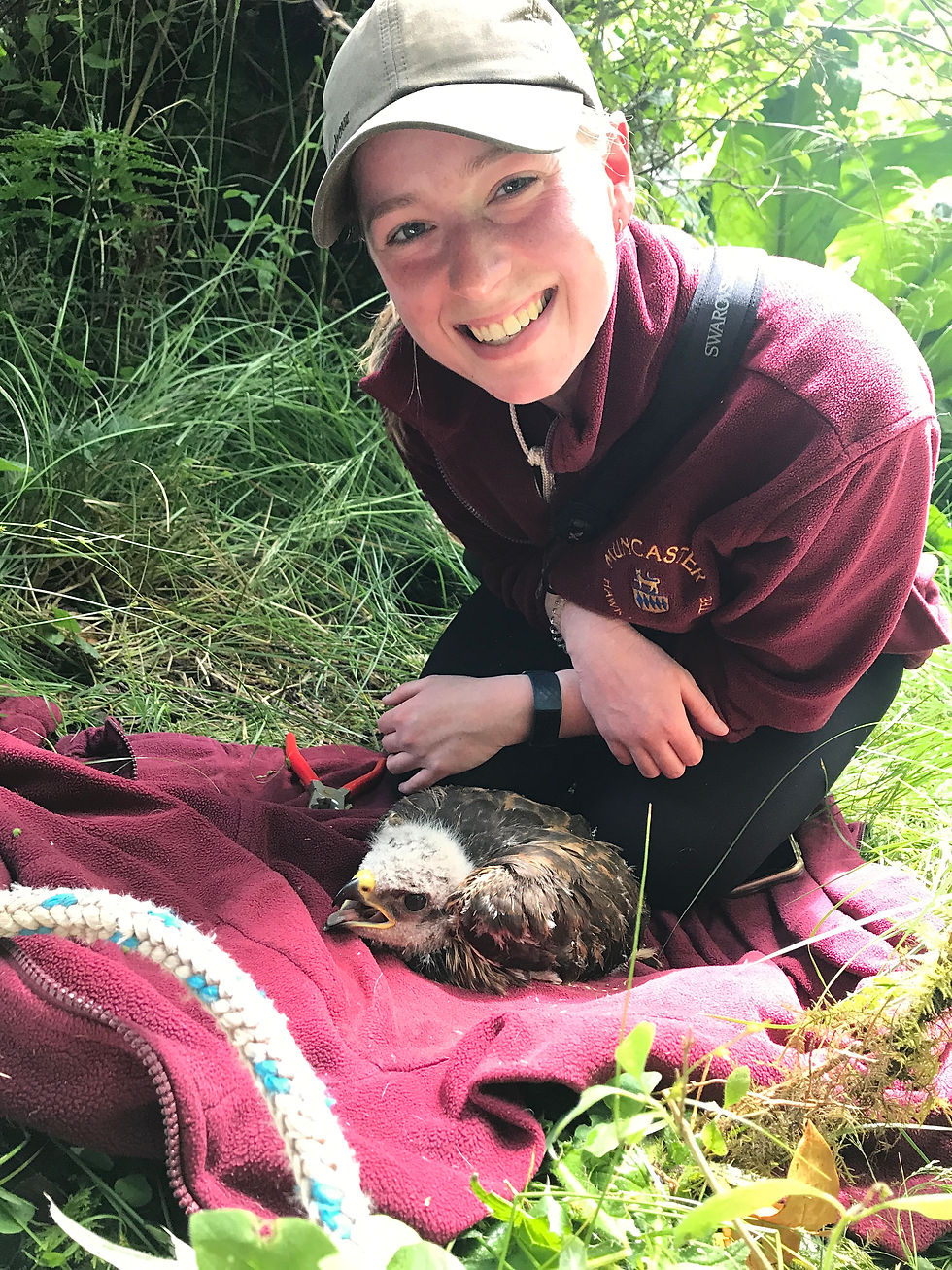
The precious cargo was lowered down to us at the base of the nest tree and when I received the bird bag, reality fully hit me. I was about to ring my first buzzard. I gently took her from the bag she was snuggled into. She felt like pure muscle in my hands. We weighed her and she came in at 810g. She was so perfect, with her dappled chocolate plumage and grey-brown eyes. I was able to fit her ring around her bright yellow leg. She had immaculate yellow feet, bulked out by thick muscle and armed with matte black talons.

Our climber Martin stayed anchored up in the tree. As we worked with the buzzard on the ground, he had a good look in the nest. He called down to us to let us know there was the remnants of grey squirrels in the nest. This was particularly good news because, not only were the buzzards eating well, but they were also contributing to conservation! Grey squirrels which are native to North America are an introduced species to the UK’s landscapes. After being deliberately released in Britain in the late 1800s, their presence has had devastating consequences for our native red squirrels. Not only are the greys larger and physically able to bully the red squirrels out of their habitats, but they also spread the squirrel pox virus to the vulnerable reds. As a result, the red squirrel population has been decimated. Happily, this area has become a red squirrel stronghold, thanks to the conservation efforts of dedicated volunteers. And the effort of buzzards too, it would seem.
With the ring fitted and our biometrics recorded, so the time came for our young buzzard to be delivered back up to her nest. Safely back in her bird bag, we sent her back up to her nest, hoisted up by ropes. Before we left the site, we checked through the scope to check all was well. She was nestled back in her spacious stick nest, happy to be home no doubt. I couldn’t wipe the ridiculous grin off my face – I just ringed my first buzzard.

Ringing the young buzzard was truly a team effort. Thank you to my trainer Colin for his expert guidance; Martin and Murray, for climbing and delivering the buzzard to and from the nest; and to Stuart, for all the emotional support.
PS. Straight after the success of ringing the young buzzard, we moved on to ring a nest belonging to another species - a clutch of spotted flycatchers, a red-list species. These are beautiful little birds that zip around, hawking insects on the wing. Since 1970, spotted flycatchers have declined by 87%. But despite this terrifying statistic, we ringed more spotted flycatcher chicks than any other species in 2022. A successful season all round!



Comments