An Adventure With Vultures, Part 1: Attending the 2023 European Vulture Conference
- Wild About Raptors - Emma
- Dec 12, 2023
- 7 min read
As the plane lifted off the runway, my stomach done a little flip. We climbed higher in the sky, the ground rushing away from beneath us and before long, the buildings below became so small they looked like toy towns. The plane ascended above the clouds revealing one of the most beautiful views I had ever seen – pure white bubbly clouds scattering sunshine as far as the eye could see. As mere mortal human beings, we only get the opportunity to fly above the clouds thanks to fixed-wing aircraft; but there are a group of birds capable of soaring up to such altitudes, as if nature personified angels – these high flyers are the vultures.

Leaving behind the UK’s mizzle, we were heading to Extremadura, Spain. The stronghold of Europe’s vultures populations, it is here you can find all five of Europe’s vulture species. It was little wonder, then, that the Vulture Conservation Foundation chose the beautiful Spanish city of Cáceres to host the second European Vulture Conference. The conference was attended by over 400 participants from 45 countries. The world’s leaders in vulture conservation were coming together to deliver the latest scientific research on vulture conservation and biology. How lucky was I to have been sent to attend by my workplace!
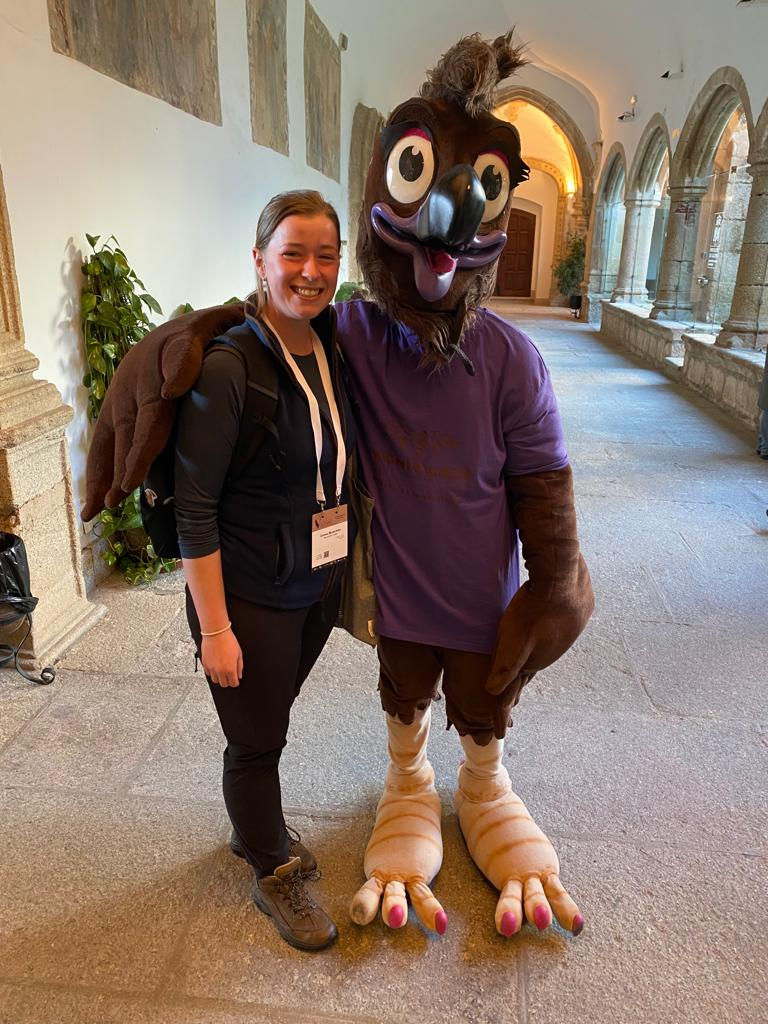
The conference took place in the most insanely beautiful building. The Complejo Cultural San Francisco building was pretty enough on the outside, but the interior of this old monastery was a little bit spectacular! We gathered along with the other delegates in the auditorium for the opening of the conference. The room buzzed with anticipation and the cheeriness of bringing like-minded people together. Already, one of the highlights of this whole experience was reuniting with old friends, getting to hug online friends for the first time and meeting entirely new friends.





The programme was kicked off by president of the VCF, Hans Pohlmann. The conference was off to an excellent start with the first piece of news being that despite some persisting threats, overall with thanks to collaborative efforts, the vulture populations found in this region of Spain are stabilising.
Unfortunately for my inner geek, multiple presentations were delivered at the same time in different locations in the building, meaning I had to choose which to attend. All of them, would have been my preferred choice, but lacking Hermione’s time-turner, I decided best to go with the presentations that were the most relevant to me, in some way or another. Below, I’ve included the links that will take curious readers directly to the VCF’s blog webpage which has a full break down of the itinerary for the European Vulture Conference. Beyond the list, I’ll be highlighting some of the presentations that I personally got rather excited about!
As a professional working in the zoological industry, I was particularly keen to attend any and all of the talks that discussed the breeding of vultures in human care. It was great to also see some representation delivered by zoo professionals such as Maarten Vis (Curator of Birds) of Rotterdam Zoo who certainly flew the flag for zoos. All good zoos play an important role in wildlife conservation – from inspiring children to care about the natural world, to raising millions of pounds annually to fund conservation and research, to facilitating endangered species breeding programmes. In fact, I wouldn’t be the raptor-crazed bird nerd that I am today if it weren’t for zoos – had I not met a Rüppell’s Griffon Vulture named Gandalf at the age of twelve years old in a bird of prey centre, I’m not sure I would have ever discovered and embraced my vulture obsession!

In a similar vein, speakers including Chandra David on the California Condor Recovery Programme – a conservation breeding programme that was facilitated by Los Angeles Zoo; Shannon Hoffman, CEO of the African Raptor Centre, on running the Bred 4 the Wild (Bearded Vulture) project; Alex Llopis, the Bearded Vulture EEP coordinator; these were just some of the professionals also from the conference that highlighted the importance of captive breeding as a conservation tool to support and bolster populations of wild vultures.
On a slightly different note, it was great to hear research direct from the field: from Rüppell’s Griffon Vultures successfully breeding (hybridising!) with Griffon Vultures in Europe; to the massive collaborative and multi-nation conservation work going on across the Balkans to protect and restore Egyptian Vulture populations; to threats affecting vultures, from avian influenza virus H5N1 to belief-based use in Africa; to release strategies for captive-bred Cinereous Vultures; to vulture skull morphology - which I definitely geeked out about. Representation from top-tier raptor organisations such as The Peregrine Fund with Darcy Ogada, who delivered a fantastic keynote talk; The Hawk Conservancy Trust/Endangered Wildlife Trust with Campbell Murn and Andre Botha respectively; Saving Asia’s Vultures from Extinction (SAVE/RSPB) with Chris Bowden, Mary Davies and John Mallord; and of course the Vulture Conservation Foundation. I will admit to being a little bit sad to have missed the one and only Jemima Parry-Jones of the International Centre for Birds of Prey, who was unable to attend due to work in the Falklands (wow!).

It wasn’t all work though (working hard or hardly working?), as we were invited to take a cultural tour of the old town of Cáceres, which was absolutely gorgeous. We stopped at a building that looked like it was straight out of a Shakespear play – but what caught my eye were the holes in the walls. I was told by a local these were for Lesser Kestrels – how lovely!

As someone who works outdoors with my hands, not in an office with computers, I find it difficult to stay engaged with PowerPoints and statistics, and worse yet PowerPoints about statistics. Hence, I couldn’t think of finer conclusion to the European Vulture Conference myself than with a field trip to Monfragüe National Park. The weather on this fourth and final day of my work trip was gloomy: but I was feeling far from gloomy – this was it! I was going to see wild vultures!
I chose a window seat on the coach, to watch the dry Spanish countryside whizz past. I soaked in everything: the free ranging pigs snuffling and truffling in the fields; livestock guardians - mammoth dogs that eyed the coach suspiciously; even cacti! (Nopal, the Spanish Optunia, I believe). We manoeuvred around the winding roads, and there on a distant pylon, was a gargantuan silhouette, head snuggled down into its body, revealing hulking shoulders - a Griffon Vulture! We sped past the sleepy behemoth, to my disappointment. My first encounter with a wild vulture, but the moment finished as quickly as it had started. Here was the species I loved … no, worshipped – but perched atop a structure that is globally responsible for the demise of its cousins. This wasn’t the deeply profound moment I had been expecting when I would finally encounter a wild vulture. But it wasn’t long before my joy was reignited.

Our first stop was Castillo de Monfragüe, where the air was saturated with mist. We began our ascension to the top of the hill and on the way, I stopped at the foot of the cliffs and there in a crevice was another Griffon Vulture. There were actually at least seven on the cliff, but this particular one I had laid my eyes on felt like this was the encounter I had dreamed of. The mist was rolling down from the hills, swirling, building the atmosphere. This real life dragon peered out from his lair. I lost my group who continued on the guided tour but I was content being left behind, mesmerised in this moment. I think I would have stayed there all day with this Griffon Vulture. My triceps burned as I switched between snapping photos and gazing through my binoculars, trying my best to lock this memory into my brain. He was beautiful – Godlike, really, with his gilt plumage and a pure white feather boa. Golden eyes that looked as though they could peer deep into your soul - not that they did, this Griffon Vulture colony regarded us with complete disinterest. Quite right too.

Before long, I was collected by one of our Spanish birding guides to reunite me with the rest of the group. Spanish is a beautiful language, but I was awkward and completely useless navigating a language that was not my own in Cáceres. Whilst the guide and I could understand very little of what each other said, passion for wildlife, as it turns out, transcends language barriers. I asked what his favourite bird was - ‘Favourite – vulture, eagle …?’ ‘Ah!’ he replied enthusiastically, ‘Eurasian Eagle Owl!’. I definitely knew what those were. Maybe I’d hear one during my stay in Extremadura!

Next stop on the field trip was Salto del Gitano. This is the place to be if you want vultures – and lots of them. Hundreds of Griffon Vultures soared in the skies above us – so many that it was difficult to know exactly where to focus my eyes. I didn’t travel to Extremadura with a species wish list, but except for one - the Griffon Vulture. When these titans soar high up to the Heavens, it is not difficult to see why vultures are considered to be angelic by some cultures. Someone shouted about a Cinereous Vulture on the rocks – through my binoculars I could see dark figure way off in the distance. Whilst that was very, very cool that I could now say I had seen not one but two vulture species, I can certainly say the Griffon Vultures, despite being the most common and easily seen European vulture species, were not being outshined. I fought hard to keep my emotions in check, to maintain a cool and professional demeanour. Internally I felt like I was inflating with happiness and wonder, the rest of the world slipping away into background noise. People from some parts of the world know a group of vultures flying together to be a ‘kettle’ – because they resemble little bubbles rising up. The kettle moved above head, my neck ached and retinas burned peering into the white sky, but I have never felt wonder like this before.

Our field trip drew to a close, and with it, the 2023 European Vulture Conference. But knowing that one day of vulture watching was never going to be enough, I had booked into a rural hotel in Monfragüe National Park for an extra week in Extremadura to carry on my big vulture adventure - Watch out for An Adventure with Vultures, Part 2: Birding in Extremadura which will follow shortly behind this – a whole week in vulture country!


Comments