Monitoring Tawny Owls
- Wild About Raptors - Emma
- Dec 27, 2022
- 6 min read
Launching the ‘Wild About Raptors’ blog was one of my highlights from this year. As 2022 draws to a close, I felt that the perfect way to wrap up the blog for this year would be to write a blog post or two about some of my favourite raptor encounters from the last twelve months. Today’s blog post recounts the awesome experience and immense privilege I had to monitor tawny owls during their breeding season and consequently having the opportunity to ring an owlet for the very first time.
Why tawny owls?
Tawny owls (Strix aluco) are a medium-sized owl found across northern Europe and here in Great Britain they are amber-listed as a species of UK conservation concern. The reasons for such population declines is currently under research, but some likely problems the tawnies face include the decimation of ideal breeding habitat. As a part of the raptor conservation efforts I’m involved with, we have installed tawny owl nest boxes over the past couple of years and monitored the boxes for signs of activity. Excitingly, a pair of tawny owls had taken a liking to one of the new boxes earlier this spring. The box hadn’t been checked since it was installed over the winter, but we suspected nesting activity after the pair were heard hooting in the area at dusk. To be sure, the box had to be investigated. Pokerfaced, I crept up the ladder and peeked through the box entrance – and there, nestled in a bed of cosy dry leaf litter, was a single perfect white egg. I could barely contain my joy, and I smiled the biggest smile until my cheeks hurt.

Monitoring the nesting attempt
The pair laid no more eggs, and so the entire success of this breeding attempt rested on this singular egg (no pressure then!). Monitoring the breeding attempt would have to be carried out sporadically over the following weeks, to keep disturbance to an absolute minimum. There are stories I had heard of fierce female tawny owls who would aggressively drive away threats (including humans) from her nest. When the time came to check on the egg again, I would be lying if I said I wasn’t even a bit nervous to be 10 metres above the ground and about to come face-to-face with an owl mum. Gulp. A tap to the side of the box would let her know I was there and give her the chance to move out of the box before checking the status of the egg. I tapped. Silence. No movement, no sound... nothing. I thought maybe she wasn’t there. Maybe the breeding attempt failed. I plucked up the courage to peek in – but she WAS there. Laying snugly at the bottom of the box, she looked comfortable; her eyelids were half closed, giving her a sleepy appearance. I descended the tree, buzzing from the adrenaline of being up the nest tree, inches from a female tawny owl. Although I didn’t get to see the egg, she didn’t fly at my face causing me to slip and fall to my death as I had feared. She stoically stayed put, silently brooding her precious clutch, keeping the secrets of the nest to herself.

Bird ringing
I continued to monitor the nest box until eventually the egg hatched. I’m not sure how much of a difference a single individual can make to the overall population of an amber listed species, but to me, this chick felt like the most important tawny owl in the world. As the chick grew and thrived under the excellent care of its parents, we hatched a plan to ring the youngster. Bird ringing is a citizen science project that has been running for over 100 years. Organised by the British Trust for Ornithology, fitting rings onto the legs of birds provides conservationists with important data about the lives of wild birds, contributing to the conservation of species and informing legislation at government level. It takes many years of training to carry out ringing activities, and I hadn’t yet ringed a raptor species as a trainee – in fact, my journey to become a licenced BTO ringer had only begun in November 2021. This was going to be a huge milestone for me.

Ringing day arrived on a mild spring day. Once all our equipment was set up, I climbed to the nest box. The chick had doubled in size since I last visited, and was now fuzzy and round, about the size of a baked potato. I reached down into the dark, warm, safe space that had been this chick’s entire world until now. I was the very first human it was ever going to encounter. I couldn’t see into the box whilst my arm was in there, so I felt around, gently tapping my fingers over the substrate until I touched the warm down feathers of the owl chick. I scooped the chick up and safely secured him into a cotton bag, so I could descend to the ground where the chick was to have his ring fitted.
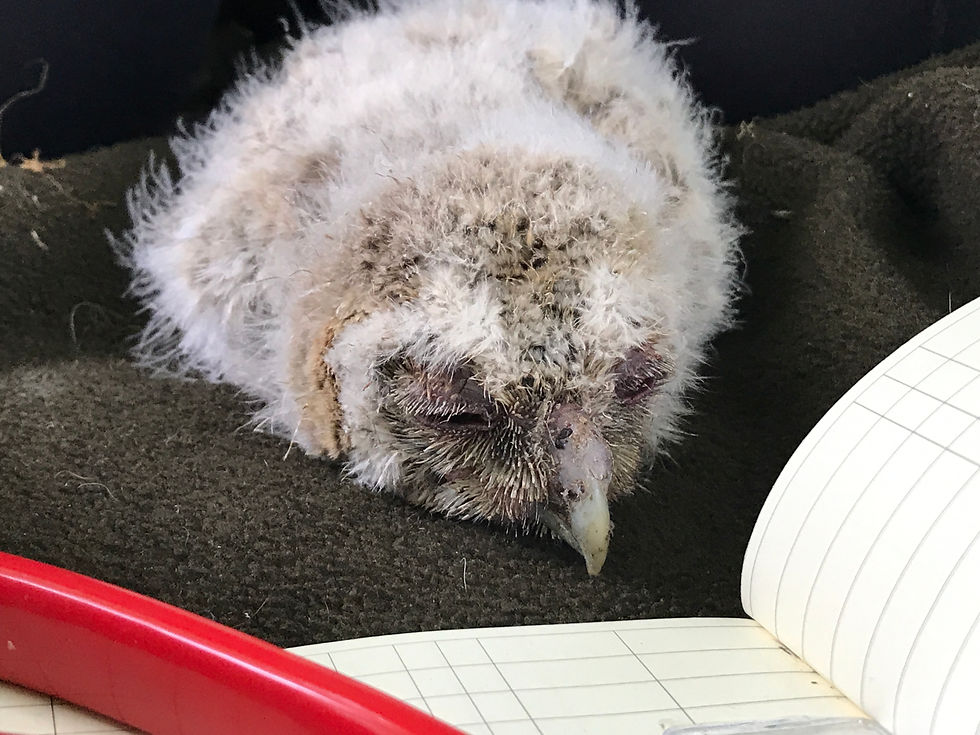
The team was there, and I think it was a big moment for them, as much as it was for me. We all care about raptor conservation, and this was the moment to see all the hard work of fundraising for, making, installing, and monitoring nest boxes finally pay off. The silence was deafening as everyone waited with bated breath. I gently extracted the owl chick from the bag to have his ring fitted, and the silence was broken as a small fluffy ball of fury came out of the bird bag, snapping his beak at the indignation of being handled. Laughter rippled through the team, easing the tension. Aside from being disgruntled, the owl chick was ok – so far, so good.

Tawny owls wear G rings, a size of ring that I wasn’t experienced with fitting. It took me a hot second to get my head around how to close the ring with larger pliers than I had been used to. Luckily, I had a good mentor and with a bit of guidance, I was able to close the ring that would now stay on this owl for the entirety of its life, all without hindering or bothering the owl in any way. With the ring fitted and our data recorded, the chick went back into a bird bag and up we went back to the nest box. I put him back exactly as I found him and wished him good luck with the rest of growing up, to one day become a fully-fledged tawny owl.

Success
Although I didn’t check directly in on the nest box again, I did visit the site again armed with my binoculars around a week after ringing the chick. I had been hoping to see the chick at the entrance hole of the nest box. Tawny owls, like most Strix owls, will leave the nest well before they can fly. This is called branching and is exactly what it sounds like. Owl chicks will explore their environment by hopping and climbing around on the branches of the nest tree. I thought maybe it was still too early for the chick to have branched, but tawny owls can and will leave their nest cavities around 35 days old. But, after sitting at the foot of a giant oak, being eaten alive by midges, waiting for the two big black eyes to appear at the nest box entrance, our attention was grabbed by the alarm calls of chaffinches, blackbirds, and blackcaps. We trained our binoculars on the large leafy branch belonging to the nest tree, the same one the songbirds were swearing at. And there, unabashed by the mobbing of the songbirds, camouflaged into the leaves, was the tawny owl chick. He had successfully left behind the security of the nest box and was now exploring this big world of towering beech and oak trees.

Update: Honestly, I thought that would be the end of the story of how I ringed my first tawny owl. But, incredibly, I was sent this next image about two months after the last sighting of the tawny owl chick. I went to the location to investigate and sure enough, I could see the ring on the right leg that confirmed this was indeed the very same owl chick! How lucky was I, to be face-to-face once more with the same young owl, who only now was suited up in full tawny owl plumage. The owl gave me the dirtiest look it could muster, before flying up into the trees. I was delighted.

Ringing my first tawny owl was both a personal and professional accomplishment. But it was a team effort and a huge thank you firstly goes to my trainer Colin for mentoring me and making this dream a reality. Secondly, to Stuart (who is also my partner) and my colleague Amy for helping me with looking for nests, helping with ladders and sharing in the endless enthusiasm for all things birds.


Comments