Top 5 Fascinating Facts about Vultures
- Wild About Raptors - Emma
- Sep 5, 2022
- 4 min read
Today’s blog is a continuation in a series of blog posts celebrating vultures during the month of September. These weird and wonderful birds possess unique adaptations and curious behaviours that make them very juicy to learn about. Read on to discover what I consider to be the top five most fascinating facts about vultures!

1. Bald is beautiful
Possibly the most iconic feature of most vultures is their bald head. In fact, many vulture species have necks and heads that are not completely featherless, and some do indeed have feathers on their heads that are very fine and soft - I bet you never expected me to tell you vultures are, well, kind of fluffy. For example, check out the epic face of a Bearded Vulture (Gypaetus barbatus). But there’s no getting away from the fact that most vulture species still are bald compared to other non-vulture bird species. The belief was held by zoologists for a long time that the lack of head feathers in vultures help the vulture to stay clean after tucking into a messy meal. From a hygiene perspective: no feathers = no problem. However, researchers from the University of Glasgow have recently suggested that the lack of feathers may also help vultures to thermoregulate.
2. It’s gettin' hot in here, so poop on all your toes
New World Vultures such as the Black Vulture (Coragyps atratus) and the Turkey Vulture (Cathartes aura) will defecate on their legs to cool down. The idea is that the wet excrement will evaporate from the legs, acting as a cooling mechanism and reducing the skin’s temperature. This practice of birds ‘urinating’ on their legs is known as urohidrosis. Put simply, in this context the vulture’s excrement serves the same purpose that sweat does for us humans (birds don’t have sweat glands). It is also thought that the uric acid helps to decontaminate the vulture’s legs of bacteria and pathogens they may have picked up from their food sources. Whilst I think urohidrosis is delightfully icky and is something straight out of a ‘Horrible Science’ book*, I’ll stick to the more socially acceptable form of sweating on hot days!
*I checked – vultures make an appearance in the ‘Nasty Nature’ edition in the ‘Horrible Science’ series. Gives me all the nostalgia.
3. Orange you fascinated by vultures yet?
Species such as the Bearded Vulture (Gypaetus barbatus) and the Egyptian Vulture (Neophron percnopterus) will bathe in iron oxide-rich mud to literally dye their feathers orange. This feather staining behaviour is formally known as cosmetic colouration.
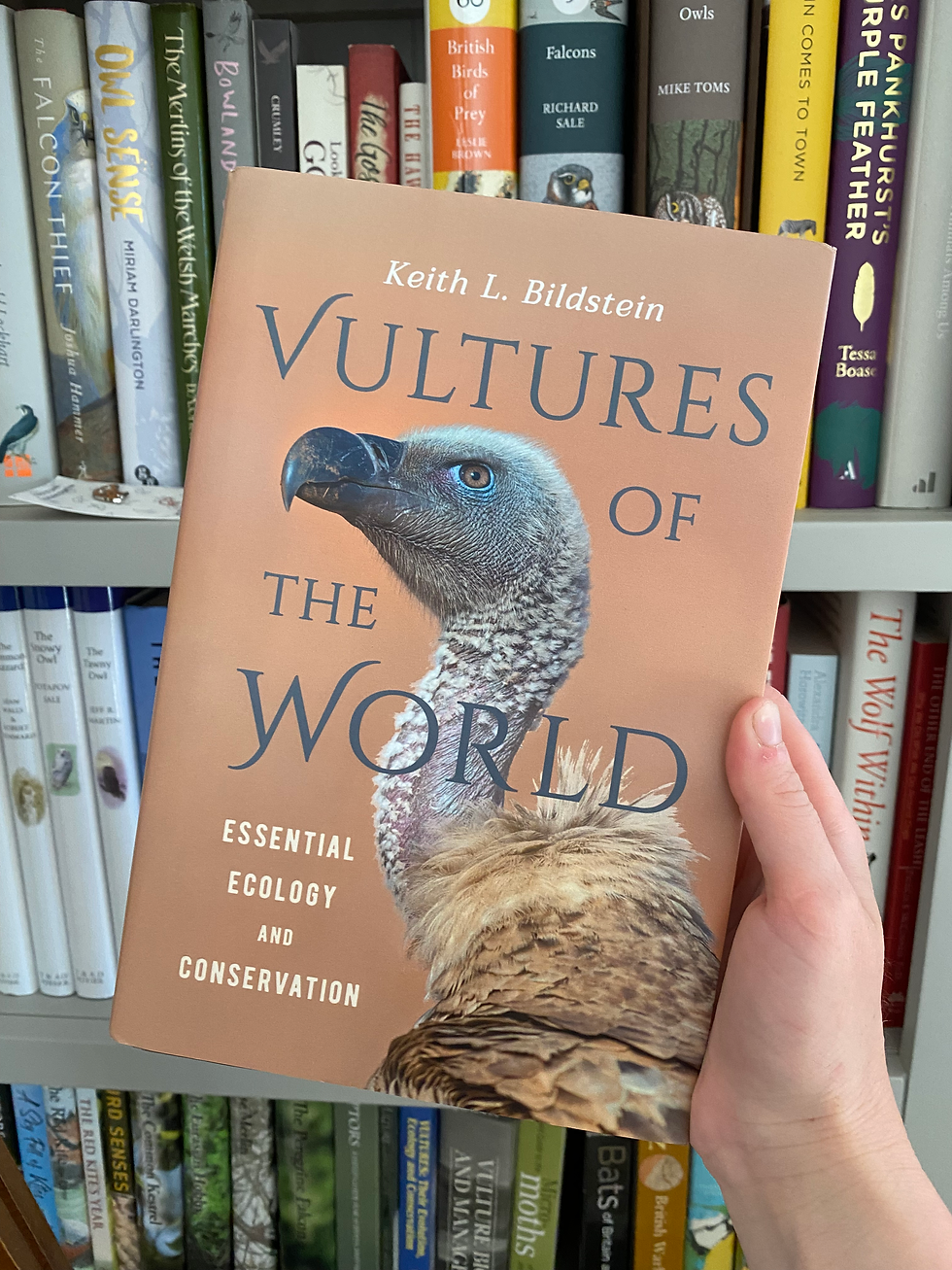
Captive populations of bearded vultures have been well documented using red mud on a regular basis to modify their feathers. Due to a lack of research on this behaviour in wild vultures, there doesn’t seem to be a clear answer for why these species practice cosmetic colouration. Some hypotheses for why vultures re-colour their feathers include social signalling or individual recognition in pair bonding (Bildstein, 2022).

4. Vultures vomit on their enemies
This tactic is an ingenious way to get some personal space, and fast! A defence mechanism designed to deter a threat, vulture vomit is highly acidic and is a sure way to keep unwanted visitors away. Vulture gastric acid is around pH1 or less, comparable to that of battery acid. Their stomach juices are acidic enough to destroy disease-causing pathogens. It is the perfect hot, stinky defence mechanism. Anyone who owns a pair of nostrils and is tempted to jump scare a vulture, should think again.

5. Vultures say no to social distancing
In 2020, ‘social distancing’ was officially added to the Collins dictionary. The noun is described by the dictionary as ‘the practice of maintaining a certain distance between oneself and other people in order to prevent infection with a disease’. But many vulture species are highly social, often feeding, roosting, and even nesting communally. Research shows that vulture social systems are quite complex (Overveld et al., 2020). Hopefully this demonstrates that, despite their sinister reputation, these intelligent and social birds are actually quite heart-warming.

Did you know that a group of vultures feasting together is known as a ‘wake’? This is likely because of the way a group of vultures will gather around a carcass. On the other hand, a group of vultures soaring together is a ‘kettle’. I’ve read before that this may be because vultures soar up in thermals, a bit like how bubbles rise in a kettle.
6. BONUS – vultures are key workers
There are so many reasons, beyond just the five listed above, why vultures are simply the best. There’s more to vultures than just what’s been mentioned here, so I had to sneak in just one more bonus reason. Because, when vultures are not keeping up with beauty trends, or social networking, or puking on their enemies, vultures are playing a key part within their habitats. Vultures are of course scavengers, consuming the remains of dead animals. By cleaning up carrion in this manner, vultures provide an ecosystem service (the Encyclopaedia Britannica describes ecosystem services as ‘processes of natural systems that directly or indirectly benefit humans or enhance social welfare’). There is evidence to suggest that vultures limit the spread of disease-causing pathogens. Just like we have essential key workers in human society - vultures are the key workers of the natural world.
As we continue devote September to all things vulture, next week’s blog discusses what exactly a vulture is. If you enjoyed the blog, please follow @wildaboutraptors on Instagram for regular updates. Thanks for reading raptor friends!


Comments