What is a Vulture?
- Wild About Raptors - Emma
- Sep 17, 2022
- 5 min read
The ‘Wild About Raptors’ blog is going wild for vultures this September. But what exactly is a vulture? In today’s blog, we look at the evolution, anatomy, and behaviour of the birds that we know as vultures.
A quick Google search generally produces search results that describes a vulture as something along the lines of a ‘large bird of prey that feeds on the flesh of dead animals.’ But the definition of a vulture is not quite that simple. For a start, lots of bird of prey species scavenge dead animals. Tawny Owls have been observed consuming carrion – but no one has declared that the Tawny Owl (Strix aluco) is officially the newest vulture on the block. Another search result distinguishes vultures as a large bird that lives in hot countries and has a featherless head. Well, vultures do live in warm climates – but so do Bateleurs and Golden Eagles. These are also species that scavenge, and yet they are not vultures either. And finally – not all vultures are bald, and other non-vulture species (such as guinea fowl and ostriches) are largely featherless around their heads and necks. Therefore, the bald head can’t be the defining feature either. So … what is a vulture?
WHAT VULTURE SPECIES EXIST?
Let’s look first at the vulture species we know today. Collectively, there are 23 separate vulture species in total which can be split into two groups – the New World vultures and the Old World vultures.
New World Vultures (family Cathartidae)
There are seven species within the group of the New World vultures, and these species are found in the continents of North and South America. This genetic lineage of vultures forms the family Cathartidae. The New World vultures include the following species:
· Turkey Vulture (Cathartes aura)
· Greater Yellow-headed Vulture (Cathartes melambrotus)
· Lesser Yellow-headed Vulture (Cathartes burrovianus)
· Black Vulture (Coragyps atratus)
· King Vulture (Sarcoramphus papa)
· Andean Condor (Vultur gryphus)
· California Condor (Gymnogyps californianus)
Old World Vultures (family Accipitridae)
This group comprises of 16 species that are distributed across the continents of Africa, Europe, and Asia. This genetic lineage of vultures forms the family Accipitridae. The Old World vultures include the following species:
· Egyptian Vulture (Neophron percnopterus)
· Bearded Vulture (Gypaetus barbatus)
· Cinereous Vulture (Aegypius monchus)
· Red-headed Vulture (Sarcogyps calvus)
· White-headed Vulture (Trigonoceps occipitalis)
· Hooded Vulture (Necrosyrtes monachus)
· Lappet-faced Vulture (Torgos tracheliotos)
· Eurasian Griffon Vulture (Gyps fulvus)
· Rüppell’s Griffon Vulture (Gyps rueppellii)
· African White-backed Vulture (Gyps africanus)
· White-rumped Vulture (Gyps bengalensis)
· Slender-billed Vulture (Gyps tenuirostris)
· Indian Vulture (Gyps indicus)
· Himalayan Griffon Vulture (Gyps himalayensis)
· Cape Griffon Vulture (Gyps coprotheres)
· Palm-nut Vulture (Gypohierax angolensis)
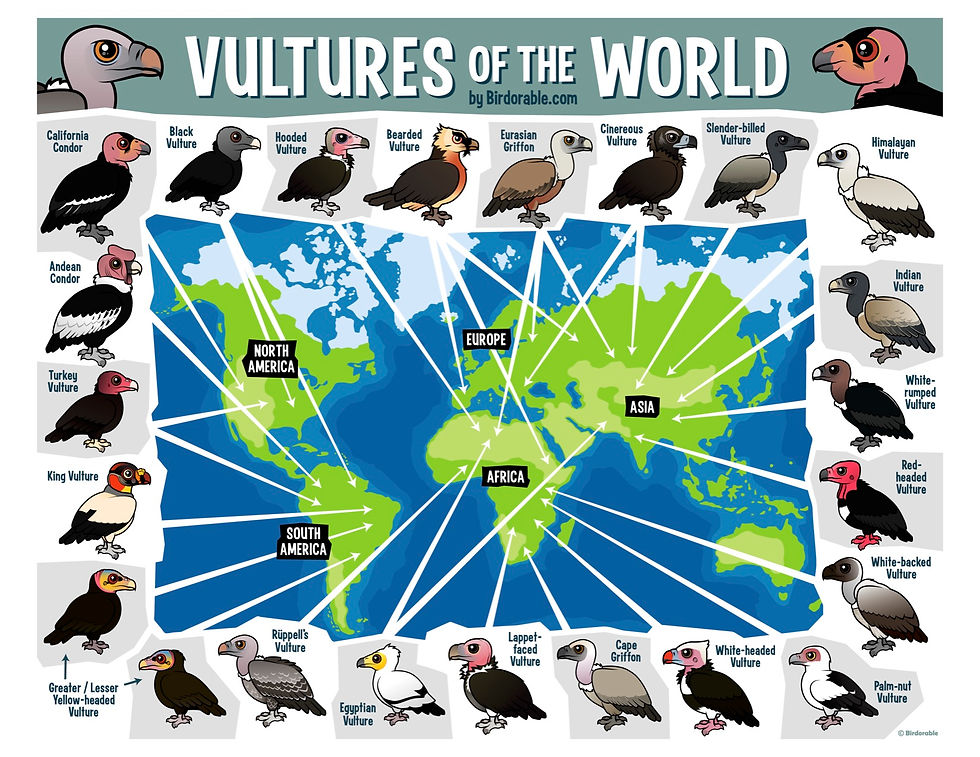
The New World vultures are only distantly related to the Old World vultures. Science shows that these two separate groups evolved independently of each other – yet they have similar adaptations. This is known as convergent evolution – the process by which the Old World vultures and the New World vultures evolved similar adaptations allowing both families to fulfil the same ecological niche – to consume carrion. Another nifty example of convergent evolution is wings that enable powered flight in both bats and birds. Whilst the New World vultures are genetically dissimilar to the Old World vultures, these two lineages have similar enough traits in their morphology and behaviour that the species within both groups can be considered under one collective assemblage that we know as vultures. Let’s look more closely at what vultures eat and why.
WHAT DOES A VULTURE DO?
Vultures principally consume carrion – that is to say, vultures only eat dead animals that they have not hunted themselves. Examples of carrion may be the remains of prey that have been hunted by predators or animals that have perished from natural causes. Although, there are exceptions to every rule in nature and vultures have been documented to hunt other animals, although this behaviour is very rare. With this in mind, vultures are known as obligate scavengers and are the only vertebrates in the entire world whose diet is almost entirely made up of carrion. On the other hand, predatory carnivores that occasionally eat dead animals are known as facultative scavengers (which is why the species mentioned in the introduction, such as the Tawny Owl, are not vultures). All vulture species share this same dietary preference of exclusively consuming dead animals.
Vultures have recently been receiving some good press for the ecosystem service they provide because of their dietary preferences. By eliminating carcasses from the environment, it is reasonable to expect that vultures either limit the spread of pathogens, or even prevent disease altogether. In addition, vulture feeding activity is essential, because in the absence of vultures, disease-carrying pest animals are likely to take over the scavenging role and ultimately, this spells trouble. We can thank vultures for keeping our world clean and healthy.
WHAT DO VULTURES LOOK LIKE?
Because of their diet, vultures have several adaptations that allows them to be successful. For example, vultures have low wing loading - the wing loading describes the relationship between the mass of the bird and surface area of the wing. Vultures have a larger wing area in comparison to the mass of their body. Their disproportionately large wings basically mean they are super buoyant. Vultures can save energy by soaring and gliding for hours, using their big wings to find lift and maintain height in the sky, whilst scanning the area for feeding opportunities.
Vultures, even the smallest vulture species such as Egyptian Vultures and Lesser Yellow Headed Vultures, have large body masses. This anatomy supports a feast-or-famine diet – essentially, when there’s food available, vultures will gorge, but their chunky bodies ensure the birds can survive episodes of food scarcity.
Of course, many vultures are indeed bald, or minimally feathered, around their heads and necks. The theory is that the lack of feathers helps the vultures to maintain good hygiene. Another brilliant adaptation is the vulture’s highly corrosive stomach acid that breaks down their meals, pathogens and all.
Behaviourally, vultures are highly social birds. They usually participate in communal feeding, particularly at large carcasses. Some vulture species also roost and even nest in communal areas. Vultures are even capable of displaying social cues, and individuals often rely on this social networking to communicate to others where feeding opportunities can be found.
Whilst only a couple of vulture species have a sense of smell that they can use to source food, all vultures have excellent visual acuity they can use to find food. As they soar, vultures will be able to locate carcasses in open terrain using their eyesight.
ARE VULTURES RAPTORS?
It is difficult to define what a bird of prey, or a raptor, exactly is. Whilst this quandary deserves its own blog post, at the very least, we can say it’s not accurate to limit the distinguishing feature of a raptor to ‘a predatory bird that seizes and kills its prey using its feet and/or talons’. Often, vultures (and owls too) are considered by some to be not true raptors. A 2019 study has suggested the defining characteristic of raptors is a shared common ancestor – a raptorial landbird. Many ornithologists and raptor-focused conservation organisations consider vultures to be raptors. Until further research shows otherwise, for now we can consider vultures to be raptors. Which is a relief, because it would be a bit hawkward for the brand new ‘Wild About Raptors’ blog to begin by blogging about a non-raptor!
WHAT IS A VULTURE?
The vultures are a small group of raptors that make up less than 1% of all bird species. There are two unrelated groups of vultures – the Old World Vultures of which there are 16 species; and New World Vultures of which there are seven species. Vultures are generally large birds that are adept at soaring, a flight style they will use to scan their environment for feeding opportunities. Vultures are obligate scavengers and are the only vertebrates whose diet consists entirely of carrion. Within the vulture group, some species possess adaptations such as featherless heads, highly acidic stomach acid, excellent visual and/or olfactory senses, and complex social networks.
There you have it. If you have ever wondered what exactly makes a vulture a vulture, then I hope this blog post has helped to clarify what a vulture is. Thanks for reading raptor friends!


Comments